
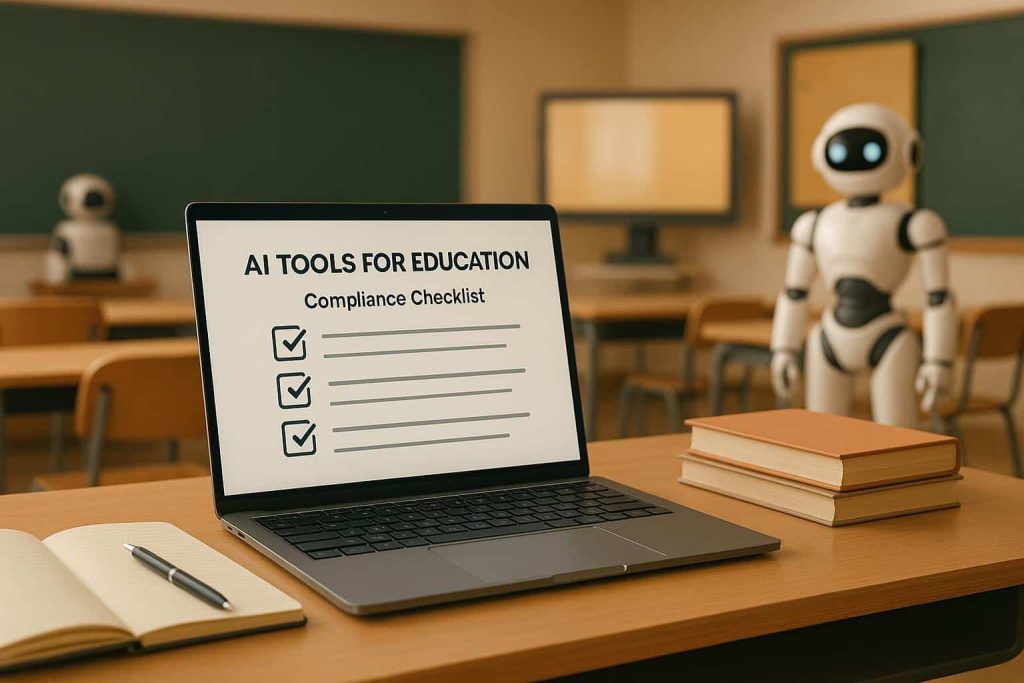
COPPA & FERPA Compliance for AI Essay Graders: A Governance-First Rationale for District Leaders
Introduction: Why AI in Writing Instruction Begins With Restraint
It is no secret that writing instruction strains the system. Not because teachers lack expertise. Not because students lack potential. But because time—finite, inflexible, indifferent—limits everything else.
Across California districts and beyond, administrators are under increasing pressure to evaluate emerging AI tools for writing assessment. The technology has arrived. Quietly. Inevitably. The question is no longer whether AI will touch writing instruction, but how it will do so without compromising student privacy or professional judgment.
This is where COPPA and FERPA matter—not as compliance hurdles, but as design principles.
An AI essay grader that cannot survive a privacy review does not belong in a classroom. Efficiency without governance is not innovation. It is exposure.

FERPA, COPPA, and the Case for Data Minimization
At its core, FERPA is not a technical statute. It is a philosophical one. It asserts that student work is not a resource to be mined, monetized, or repurposed.
District leaders evaluating an AI essay grader for schools typically begin with four non-negotiable questions:
- Does the system process assignment text only, without behavioral, demographic, or biometric data?
- Does the district retain full ownership, with no secondary use for training or marketing?
- Are retention and deletion policies explicit, enforceable, and documented?
- Do teachers control when feedback is generated—and how it is used?
These questions appear simple. They rarely are.
Many automated essay grading software platforms rely on persistent identifiers, long-term storage, or opaque training pipelines. Such architectures introduce risk—not because they are malicious, but because they are misaligned with educational stewardship.
Data minimization is not about doing less. It is about doing only what is defensible.
Why Every District Pilot Needs a DPIA
Understandably, AI is often described as a black box. Student data deserves light, not opacity.
That is why responsible districts begin with a Data Protection Impact Assessment (DPIA) before the first essay is uploaded. During the opening weeks of a pilot, legal counsel, IT leadership, and curriculum directors typically review:
- What data enters the system—and what never should
- Who can access feedback outputs
- How long student writing persists
- Where deletion is verified, not assumed
Some see this process as delay. In practice, it is ballast. It keeps the pilot upright once momentum builds.
When pilots include an example configuration using Essay Eye, the intent is demonstration, not endorsement. The setup illustrates how an AI essay grader chrome extension can operate without student profiles, persistent identifiers, or automated decisions.
The system evaluates text.
Teachers decide everything else.
Full stop.

The Myth of the Neutral Algorithm
No writing assessment tool is neutral. Rubrics encode values. Feedback reflects priorities. AI merely amplifies what already exists.
This is why FERPA compliance cannot be separated from pedagogy. If a tool accelerates feedback but bypasses teacher judgment, it fails—ethically and instructionally.
Some worry this level of caution slows innovation. More often, it accelerates trust. And in schools, trust is not optional.
Conclusion: Governance Is the Innovation
What districts are really deciding is not whether to adopt AI, but whether to govern it.
A FERPA-aligned AI writing assessment tool for districts respects boundaries. It minimizes data. It documents decisions. It leaves authority where it belongs.
Teaching has always been human work. Compliance simply ensures that it stays that way.